
PsychonautDream
When Fungi Become Art: Why Mushrooms Keep Escaping the Lab and Invading Galleries

When Fungi Become Art: Why Mushrooms Keep Escaping the Lab and Invading Galleries

Mushrooms have become impossible to keep in their lane.

They were already food, poison, medicine, sacrament, decomposer, internet mascot and recurring guest star in the human imagination. Now they are increasingly material for contemporary art — not merely painted as cute caps in a forest, but used to think about networks, bodies, decay, communication and the uncomfortable possibility that the world is less individual than we prefer to imagine.

A new exhibition at the Royal Albert Memorial Museum & Art Gallery in Exeter makes that shift unusually visible. Living Labyrinths: Art and Fungi, running from October 3, 2026 through February 21, 2027, brings together scientific collections and contemporary art across ceramics, glass, photography, painting and textiles.

The subject is not “mushrooms are pretty.” The subject is relationship.

Mycelium ruined the metaphor for everyone

Once you learn that the mushroom above ground is only the visible fruiting body of a much larger fungal organism, it becomes difficult not to abuse the metaphor.

Writers do it. Designers do it. Tech companies absolutely do it. Everything becomes a network. Everything is interconnected. Somewhere a presentation deck grows a white branching diagram and calls itself mycelial.

But fungi remain compelling precisely because the reality is stranger than the metaphor. Fungal systems occupy borders that humans like to keep tidy: organism and environment, death and fertility, individual and network, visible and hidden.

That is unusually fertile territory for artists.

Living Labyrinths includes interpretations of mycorrhizal networks, historical fungal specimens and natural-history drawings. Two new commissions grew directly from museum collections: a large-scale drawing of the human mycobiome by Gemma Anderson-Tempini and bio-sonic sound art of mycelial networks by Jason Singh.

The fungus is no longer just being represented. Its relationships become material for the work.

Beatrix Potter was here before the mushroom merch

The exhibition also includes fungi watercolors by Beatrix Potter — yes, that Beatrix Potter — alongside Cy Twombly’s 1974 collage series Natural History, Part I, Mushrooms and work by eight contemporary artists.

That range matters.

The current mushroom boom can look very new because its visual language is everywhere: apparel, posters, tattoos, packaging, festival graphics, animation, wellness branding. But artists and illustrators have been staring at fungi for a very long time. The reasons change. Scientific observation becomes symbolism. Symbolism becomes counterculture. Counterculture gets printed on a tote bag. Then a museum places the tote bag’s distant visual ancestors beside contemporary bio-art and the loop becomes delightfully difficult to untangle.

Mushrooms are excellent at this. They make categories rot at the edges.

The psychedelic mushroom is only one mushroom story

For a psychedelic-art site, there is an obvious temptation to treat every fungus as a prelude to psilocybin. That would be lazy.

Fungi have a visual and cultural life much larger than psychedelics. They carry associations with decomposition, rebirth, folklore, poison, fairy rings, hidden systems, medicine, soil and transformation. Psilocybin mushrooms add altered perception and countercultural history to that already crowded symbolic bag.

The result is why mushroom imagery works so well in art even when nobody is depicting a trip.

A cap and stem can be a botanical object. A portal. A joke. A warning. A tiny umbrella over an invisible kingdom. Context does the heavy lifting.

That is also why the most interesting mushroom art usually does more than repeat a red cap with white spots and apply neon until surrender.

Fungi fit the psychedelic imagination because they challenge scale

Psychedelic art often plays with the instability of scale: microscopic becomes cosmic; skin becomes landscape; a pattern repeats until it seems to have its own laws.

Fungi naturally invite the same move.

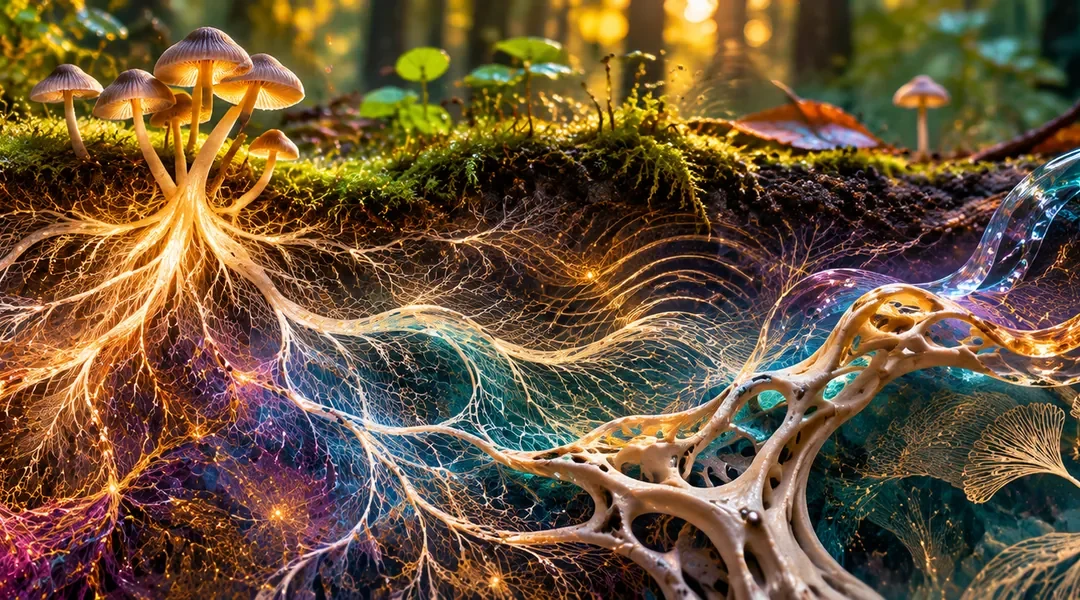
Look at a mycelial network and it resembles roots, neurons, rivers, lightning, veins, maps. None of those comparisons makes the fungus any of those things. But visual resemblance lets the mind jump levels of organization. Suddenly a forest floor looks anatomical. The body looks ecological. A network becomes a landscape.

That jump is close to the heart of psychedelic visual language: not merely bright color, but the sense that one thing might be secretly rhyming with another.

The museum is telling us something else, too

When institutions build exhibitions around fungi, they are documenting a broader cultural shift. Mushrooms are no longer confined to botanical illustration, food culture or psychedelic subculture. They have become a serious design and art vocabulary.

That creates opportunity and risk.

The opportunity is richer work: artists can engage ecology, material science, indigenous knowledge, medicine, folklore and altered states without collapsing them into one aesthetic soup.

The risk is exactly that soup.

“Mushroom” can become a decorative shortcut for nature, mysticism and psychedelic identity all at once. When a symbol means everything, it eventually means very little.

The better work asks a more specific question: what is the fungus doing here?

Is it decay? Communication? Transformation? Humor? Network? Body? Portal? Evidence?

That question is much more interesting than whether the cap glows.

For more of PsychonautDream’s own mushroom visual territory, browse the Magic Mushroom Clothing collection or meet the artist behind the site, Raul Lopez Pomares.

Source

The FDA Is Building a Rulebook for Psychedelics. What Actually Changed in 2026

The FDA Is Building a Rulebook for Psychedelics. What Actually Changed in 2026

Psychedelics have spent decades being discussed as medicine, menace, sacrament, counterculture, investment thesis, and occasionally all five before lunch. In 2026 they acquired something less romantic but more consequential: a proper stack of regulatory paperwork.

In July, the U.S. Food and Drug Administration finalized its guidance Psychedelic Drugs: Considerations for Clinical Investigations. The document is aimed at sponsors developing psychedelic drugs for medical conditions and addresses the unusual problems that arise when the intervention can temporarily and dramatically alter perception, mood, cognition and the participant’s relationship to the room around them.

That is a real milestone. It is not an approval. It is not legalization. It is not the FDA declaring that psychedelics work for every condition currently being attached to a pitch deck.

Those distinctions matter.

What the FDA actually did

The FDA’s final guidance turns a once-niche research area into something the agency now has a dedicated framework for discussing. The agency says interest in therapeutic psychedelics has increased and that clinical trials with these compounds create “unique challenges.” The final document replaces draft guidance first issued in 2023.

The practical significance is straightforward: companies and academic sponsors planning trials no longer have to infer every expectation from guidance written for more conventional drugs. Psychedelic studies still live under the same broad standards for evidence, safety and drug development, but the agency is explicitly acknowledging that these compounds create additional trial-design questions.

In September, the FDA also held a public hearing on the potential future therapeutic use of psychedelic drugs in supervised and supportive settings. That hearing opened another channel for discussion about how treatment might eventually work outside the neat geometry of a clinical trial.

The important word there is eventually.

A rulebook is not a green light

Psychedelic coverage has a recurring problem: one bureaucratic step becomes a headline announcing the arrival of the future.

Final guidance means the FDA has clarified how it wants sponsors to approach development. It does not mean a particular psychedelic product has been shown safe and effective. Each drug, formulation and indication still has to make its own case with data.

That is especially important because “psychedelics” is a category broad enough to hide enormous differences. Psilocybin, LSD, MDMA, ibogaine and 5-MeO-DMT do not share one risk profile, one duration, one mechanism, one evidence base or one plausible model of care. A regulatory framework can organize the questions. It cannot erase those differences.

Why psychedelic trials are unusually difficult

A conventional drug trial likes clean boundaries. Give treatment A, compare it with treatment B or placebo, measure the outcome, try to keep everyone blinded to what they received.

Psychedelics are not particularly cooperative with that aesthetic.

A participant may have a conspicuous acute experience. Expectations can influence reports. The surrounding environment may matter. Psychological support can be part of a protocol without being the investigational drug itself. Acute effects may require monitoring. Longer-term benefits and harms can be difficult to separate from what happened before, during and after the dosing session.

The result is not that psychedelic science is impossible. It means good psychedelic science has to be unusually honest about context, controls and what its data can actually prove.

That is a healthy development for a field with no shortage of enthusiasm.

The interesting shift is cultural as much as regulatory

There is something strange about watching substances associated with 1960s posters, indigenous ceremonial traditions, underground experimentation and moral panic become the subject of federal guidance documents.

Culture tends to flatten that transition into a simple story: forbidden thing becomes accepted thing. Reality is messier. Institutionalization changes the thing being institutionalized.

A molecule in a laboratory is not a ceremony. A supervised medical session is not a festival. A regulated drug product is not the same object, socially or legally, as a mushroom, cactus or brew with centuries of cultural history attached to it.

The FDA is not resolving those contradictions. It is doing something narrower: defining how drug developers should generate evidence the agency can evaluate.

That may sound boring. It is also how fields stop surviving on anecdotes alone.

What to watch next

The next useful questions are less dramatic than “Are psychedelics legal yet?” and much more important:

  • Which compounds and indications produce convincing late-stage evidence?
  • How will studies separate drug effects from expectation and supportive context?
  • What safety monitoring will different compounds require?
  • How will regulators think about supervised care around a drug without confusing the two?
  • If products are approved, who will realistically be able to access them and under what conditions?

Those questions will not be answered by one guidance document. But in 2026, the FDA made clear that psychedelic drug development is now a field substantial enough to require its own regulatory grammar.

The counterculture has met the footnote. The footnote may turn out to matter quite a lot.

Sources and further reading