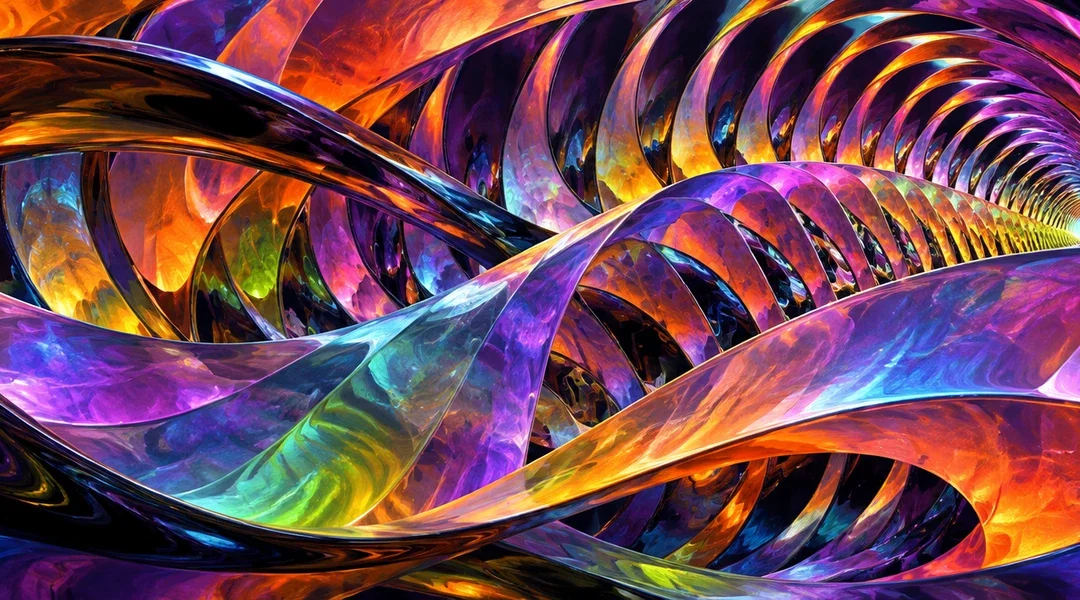
AI can generate a thousand fractal eyes before lunch.
It can melt a cathedral into a jellyfish, place a mushroom forest inside a pupil, lace everything with sacred geometry and then politely ask whether you would like four more variations.
By the visual shorthand of the internet, generative AI is extremely good at psychedelic art.
Which creates a more interesting question:
Is it making psychedelic art, or has it simply become very fluent in the symptoms?
Generative systems are built to learn statistical relationships across enormous bodies of images. A style with strong recurring visual signals is therefore highly learnable.
Ask for “psychedelic” and the model can produce the category’s average accent with astonishing speed.
That is technically impressive.
It is also precisely why style has become less valuable as proof of artistic intention.
If a machine can produce the recognizable surface on demand, the human artist has to bring something more interesting than recognition.
Psychedelic art was never only a look
Historically, psychedelic visual culture grew out of particular technologies, music scenes, altered-state experiences, spiritual traditions, countercultures and experiments in perception.
Those contexts were inconsistent, contradictory and sometimes deeply problematic. They were also lived.
A generative model does not need to have seen an impossible color behind closed eyes to reproduce visual conventions associated with that description. It does not need a body to render body dissolution. It does not need a mystical experience to draw one.
That does not automatically disqualify the image as art. Cameras do not have memories and paintbrushes do not believe in God.
Tools have never needed experiences.
Artists do.
The real issue is where authorship and decision-making live.
The artist’s job is increasingly selection
Making images has always involved selection: this line, not that one; this crop; this material; this accident worth keeping; this mistake worth destroying.
Generative systems multiply the number of possible outputs until selection becomes even more central.
Typing a prompt is a decision. Rejecting ninety-nine outputs is a decision. Combining, repainting, editing, distorting, printing, sculpting or otherwise transforming a result can become a chain of decisions.
The interesting question is not whether AI touched the process. It is whether a person developed a point of view through the process.
A thousand images are not a body of work merely because they share a prompt.
Hallucination is an unfortunate marketing advantage
Generative AI famously produces confident visual impossibilities: impossible anatomy, unstable architecture, objects merging into one another, patterns with no physical explanation.
Those failures can look suspiciously psychedelic.
The irony is excellent.
A system’s inability to maintain ordinary object boundaries can resemble an artistic tradition that intentionally destabilizes object boundaries.
But resemblance is not intention.
An error becomes artistically interesting when someone recognizes what the error is doing, chooses it, contextualizes it and builds with it.
Otherwise it is just a very decorative malfunction.
AI exposes how much generic psychedelic art was already formulaic
This may be the uncomfortable part.
If AI can produce convincing “psychedelic art” instantly, it is partly because the category already contains an enormous amount of formula.
Mushroom + eye + fractal + neon + cosmic background is easy to learn because people have repeated it for years.
The machine is not solely flattening the aesthetic. It is revealing where the aesthetic was already flat.
That is useful pressure on artists.
It makes first-party process, material experimentation, personal symbolism, physical craft, cultural specificity and a coherent body of work more important, not less.
The best use of AI may be as an instrument, not an oracle
Artists have always used tools that change what they can see: mirrors, cameras, projectors, photocopiers, synthesizers, 3D software, procedural code.
Generative AI can belong in that lineage when it becomes part of a deliberate process rather than a substitute for one.
Use it to produce an impossible seed. Break it. Paint over it. Rebuild it. Translate it into another material. Compare what the system defaults to with what you actually wanted. Treat its clichés as evidence.
The point is not to prove human purity. Art has never been pure.
The point is to preserve authorship as something more substantial than pressing the button until the machine becomes flattering.
PsychonautDream is built around the work and visual identity of Raul Lopez Pomares. That makes AI interesting here not as a replacement for the artist but as another pressure on the question the site has always had to answer: what makes an image belong to a particular mind rather than merely to a category?
You can browse the site’s Visionary Dreamscapes and decide where you think that line lives.
AI can imitate the symptoms very well.
The art begins when somebody has a reason for keeping them.
The fastest way to make something look psychedelic is also the fastest way to make it look like everybody else’s idea of psychedelic.
Add an ultraviolet gradient. Warp the type. Insert a mushroom. Add an eye inside the mushroom. Give the eye a galaxy. Make the galaxy drip.
Congratulations. The software has completed its pilgrimage.
The problem is not that any of those devices are forbidden. Psychedelic art has earned its visual vocabulary honestly. The problem is what happens when vocabulary replaces thought.
That question feels especially timely as the Psychedelics Design digital festival returns November 6–7, 2026, bringing designers, artists, researchers and advocates into the same conversation about creative practice, psychedelic experience and regenerative futures.
If psychedelic design is becoming a discipline rather than a style preset, it should probably stop making the same mistakes.
Mistake 1: confusing sensory intensity with visual intelligence
More is not automatically more psychedelic.
More saturation, more distortion, more pattern, more motion and more detail can eventually produce less experience because the viewer stops distinguishing anything.
Intensity works when there is contrast with restraint.
A single unstable form in a calm composition can be more disorienting than thirty effects shouting simultaneously. Silence is useful in music for the same reason empty space is useful in design: without it, nothing gets to become an event.
Mistake 2: treating neon as a historical obligation
Psychedelic visual culture includes extraordinary color, but it does not own a fixed palette.
Muted earth tones can be psychedelic. Black and white can be psychedelic. A nearly monochrome image can destabilize perception through texture, repetition or impossible geometry without asking magenta to carry the entire spiritual burden.
Color should create relationships, not certify membership in a genre.
Mistake 3: using sacred or indigenous motifs as decorative seasoning
This one is less funny.
Psychedelic culture overlaps with indigenous traditions, ceremonial practices and symbols that have specific histories and meanings. Pulling those motifs into commercial design because they “feel spiritual” can flatten living traditions into visual texture.
Research the source. Understand whether the symbol belongs to a particular people, practice or context. Do not assume that admiration removes the need for care.
A design can be culturally curious without behaving like a souvenir shop after a vision quest.
Mistake 4: believing the mushroom is doing the concept’s job
A mushroom tells the viewer what shelf to put the design on.
It does not automatically give the design an idea.
The same is true of eyes, portals, mandalas, skeletons and extraterrestrials. Symbols are useful because they carry associations. But when every association is imported ready-made, the artist has contributed very little besides arrangement.
Ask what happens if the icon disappears.
If nothing remains except a nice gradient, the symbol was doing unpaid overtime.
Mistake 5: designing for recognition instead of perception
The most interesting psychedelic work does something to seeing.
It destabilizes figure and ground. It creates multiple readings. It manipulates scale. It hides structure inside structure. It turns repetition into motion. It creates a visual rule and then violates it exactly when the viewer learns the rule.
That is more difficult than assembling recognizable psychedelic ingredients.
It is also why the work has a chance to remain interesting after the first glance.
Mistake 6: forgetting the medium
A dense poster can be glorious and become unreadable on a shirt. A repeating textile can sing on fabric and feel dead as a centered rectangle. An animation can use time as a compositional element while a print has to imply motion without moving.
Designing one master image and resizing it into submission is production, not adaptation.
Psychedelic imagery is especially sensitive to this because so much of its effect depends on scale, detail and visual rhythm.
The medium is part of the composition whether the designer acknowledges it or not.
Mistake 7: sanding away the discomfort
Commercial psychedelic design often wants the category’s excitement without its strangeness.
The result is pleasantly weird but never actually destabilizing: a friendly hallucination approved by the brand team.
There is a place for accessible work. Not everything has to threaten consensus reality before breakfast.
But if every edge gets rounded, psychedelic becomes a decorative adjective rather than an artistic problem.
Some ambiguity is worth protecting.
Psychedelic design should be harder to imitate than a filter
The category has matured enough that style alone is no longer a strong idea.
That is good news.
It pushes artists and designers toward the questions underneath the look: perception, consciousness, embodiment, ecology, symbolism, transformation, ritual, absurdity, technology and the unstable border between inner and outer worlds.
There is a point where “psychedelic gift” becomes code for a rainbow mushroom printed on an object that did not deserve what happened to it.
We can do better.
A good psychedelic gift should still make sense after the novelty evaporates. It should fit the person, the room or the ritual of daily life. Ideally it should also look as if somebody made an aesthetic decision rather than losing a bet with a print-on-demand algorithm.
So this guide is organized by type of human, which is more useful than organizing it by objects.
For the person whose walls are visibly under-medicated
Go with art.
A poster is the easiest way to give someone a large dose of visual personality without guessing their shirt size or whether they secretly hate mugs.
The Psychedelic Art Posters collection ranges from dense, visionary imagery to stranger dreamscape territory. Posters also let complex artwork breathe at a scale where details remain details instead of becoming decorative lint.
Best for: artists, collectors, students, music people, maximalists, office-wall rebels and anyone currently living under the tyranny of beige.
For the walking canvas
Some people wear neutral basics because they want clothing to disappear.
This section is not for them.
The Psychedelic T-Shirts collection is the obvious starting point for somebody who likes graphic art to travel with them. If the recipient prefers more fabric between themselves and civilization, try Psychedelic Hoodies.
The trick with clothing gifts is choosing the person before choosing the design. Are they actually into mushrooms? DMT lore? dreamscapes? absurd humor? meditation? classic psychedelic history?
“Likes psychedelics” is not a personality. Thankfully.
For the person who writes things down before reality edits them
A journal is quietly one of the best psychedelic-adjacent gifts because it does not require anyone to be psychedelic at all.
Writers, sketchers, dream recorders, obsessive list makers and people who insist they had an important thought at 3:17 a.m. all have a use for one.
Browse Psychedelic Journals & Notebooks if you want the artwork to live on something that collects new material rather than merely displaying itself.
For the kitchen philosopher
A mug is a small domestic stage for an image.
That makes Psychedelic Mugs & Tumblers good for the person who wants their morning coffee to imply that consensus reality remains under review.
It is also one of the safer gifts when you know someone’s taste but not their measurements.
For the person who treats accessories as punctuation
Scarves are useful because they can be subtle or completely unreasonable depending on how they are worn.
The Psychedelic Scarves collection works particularly well for designs that benefit from movement and folds. A flat image becomes fragmented, hidden and revealed as the fabric moves.
For the person whose footwear is already doing most of the talking, there are also Psychedelic Shoes.
You know whether your person is that person.
For the mushroom person
Every friend group contains somebody for whom fungi stopped being an interest and became a taxonomic identity.
The Magic Mushroom Clothing collection is the direct route, but do not assume mushroom art has to mean cartoon caps and neon spores. Fungi carry an enormous visual vocabulary: networks, decay, folklore, transformation, ecology, absurdity and yes, psychedelia.
Choose the image, not just the keyword.
For the psychonaut who already owns everything obvious
Go sideways.
Browse the Shop All Collections directory by theme rather than product. You can move through dreamscapes, DMT entities, ego dissolution, meditation, Stoned Ape theory, ayahuasca, peyote, fae and other visual territories without deciding first whether the object should be a shirt or a poster.
This is usually how better gifts happen: start with the person’s strange little universe, then choose the format.
A brief anti-gift-guide manifesto
Do not buy somebody psychedelic art because it contains the largest possible number of recognized psychedelic symbols.
Buy the piece because the image is good.
That sounds embarrassingly obvious, but the category is full of designs that behave like keyword clouds: mushroom, eye, mandala, alien, fractal, repeat until enlightenment or inventory clearance.
Original art should feel like a point of view.
PsychonautDream is built around artwork by Raul Lopez Pomares, then adapted across different objects and formats. That means you can choose by visual language rather than shopping for a generic idea of “trippy.”
The best psychedelic gift does not say, “I searched psychedelic gifts.”
It says, “I know exactly which kind of strange you are.”
Psychedelic safety discourse has two favorite settings: “basically harmless” and “obviously dangerous.”
Reality, as usual, has declined the invitation to become a slogan.
A study published September 29, 2026 in JAMA Network Open examined self-reported adverse health outcomes among U.S. adults who had recently used psilocybin, LSD, MDMA, ibogaine or 5-MeO-DMT. It is useful because controlled clinical trials do not tell us everything about what happens when these substances are used in the general population.
It is also exactly the kind of study that can be mangled by a headline if the limitations disappear.
What researchers studied
The analysis used data from the 2025 National Survey Investigating Hallucinogenic Trends, a double opt-in online panel survey of adults across all 50 states. The data were weighted against a nationally representative anchor survey.
Among 1,964 adults in the analysis, reported past-year use included 1,151 respondents for psilocybin, 376 for LSD, 539 for MDMA, 74 for ibogaine and 95 for 5-MeO-DMT. People who reported recent use were asked about physical and mental-health changes, health-care use and a set of symptoms they attributed to each substance.
The study found that self-attributed adverse outcomes were most frequent among respondents reporting ibogaine or 5-MeO-DMT use. Because psilocybin, LSD and MDMA were more commonly reported, the estimated total number of people experiencing adverse outcomes was larger for those substances.
That is worth knowing.
Now comes the equally important part.
This study does not prove causation
The design was cross-sectional. Researchers measured reported use and reported outcomes; they did not randomly assign substances or control everything else happening in participants’ lives.
The authors explicitly note that the design cannot establish causality.
Preexisting psychiatric history could differ between groups. People may have used other substances. Respondents were asked to attribute symptoms to a drug themselves, and that attribution could vary depending on how dramatic or physically demanding an experience felt.
The ibogaine and 5-MeO-DMT groups were also relatively small, producing wider uncertainty around estimates.
In short: the outcomes are signals, not verdicts.
Why real-world safety data still matter
Clinical trials deliberately select participants, control dose and purity, screen for risks and provide supervision. Those conditions are features, not flaws, when the goal is to test an intervention.
But they are not the conditions under which every person uses a psychedelic.
General-population data can reveal patterns that highly controlled studies may miss: unsupervised use, uncertain products, combinations with other drugs, medical vulnerabilities and different motives for use.
The price is weaker causal certainty.
This is why safety surveillance needs multiple kinds of evidence rather than one definitive study that settles everything forever.
“Psychedelics” is too broad a safety category
One useful implication of the study is how quickly the umbrella term breaks down.
Ibogaine has a very different physiological risk profile from psilocybin. 5-MeO-DMT produces a very different acute experience from LSD. MDMA is pharmacologically distinct from classic psychedelics even though it often appears in the same therapeutic conversation.
Treating all of them as interchangeable can make both enthusiasm and fear scientifically sloppy.
The better question is always more specific: which substance, which dose, which person, which context, which outcome, over what period?
That is less exciting than “Are psychedelics safe?” It is also a question evidence can actually approach.
The field needs boring honesty
Psychedelic medicine has attracted investment, activism, personal testimony and legitimate scientific interest. That mix creates powerful incentives to simplify.
Positive trial? Breakthrough.
Adverse-event survey? Disaster.
Neither reflex helps people understand risk.
The authors of the new study land somewhere more useful. They argue that the findings support continued safety surveillance, targeted harm reduction where warranted and balanced public-health communication about both potential risks and benefits.
That is not fence-sitting. It is what uncertainty looks like when it has grown up.
If psychedelic science wants public trust, it cannot treat inconvenient data as hostile and it cannot treat every alarming association as proof.
The interesting work is in the middle, where the evidence is usually messier and more informative.
“Trippy” is useful in the same way “tasty” is useful at a restaurant.
It communicates a reaction. It does not give us much to work with.
Psychedelic art deserves better verbs.
You do not need an art-history degree, a pharmacology background or a scarf collection of suspicious size to look at psychedelic art seriously. You need questions that move past whether the image is colorful and weird.
Here are some.
First: where does your eye go, and who sent it there?
Every image has traffic patterns.
Look for the first place your eye lands. Then notice where it moves next. Does the composition funnel you toward a center? Push you around the edges? Trap you in a loop? Scatter attention across dozens of equally loud details?
Psychedelic art often plays with the desire for a stable focal point. Sometimes the center is obvious. Sometimes every detail behaves as if it is running for office.
Neither approach is inherently better. The useful question is whether the competition feels intentional.
What is space doing?
Ordinary images usually try to maintain a coherent world. Psychedelic images often enjoy making that world unreliable.
Look for impossible depth, nested spaces, flattened perspective, tunnels, mirrored architecture, forms that switch between object and void, and boundaries that cannot decide whether they are inside or outside.
Ask yourself: could this space exist?
If not, how exactly is it cheating?
That answer tells you more than “it looks surreal.”
Follow the repetition
Repetition is one of the quickest routes from decoration to altered perception.
Notice what repeats and what changes. Are motifs identical, gradually transformed, mirrored, rotated, nested or interrupted?
A repeated form creates expectation. A changed form breaks it. The dance between those two things can make a static image feel as if it is moving.
This is why some psychedelic work becomes more active the longer you look. Your visual system starts learning the pattern, only to discover the pattern has been lying.
Color is behavior, not inventory
Do not merely list colors. Ask what they are doing to one another.
High-contrast complements can make edges vibrate. Similar values can flatten depth. A warm color may advance while a cool field appears to recede. An unnatural palette can make a familiar object feel alien without changing its shape at all.
Sometimes the most important color is the one that is barely there.
And yes, psychedelic art can be monochrome. Nobody from the Council of Fluorescent Magenta will revoke the license.
Look at scale
A tiny detail can behave like a universe. A human face can become landscape. A cell can resemble a planet.
When scale becomes ambiguous, the image weakens the normal hierarchy between body, object and cosmos.
That is not just a psychedelic cliché. It is a powerful perceptual device because scale is one of the ways we decide what kind of thing we are looking at.
Take scale away and identity gets slippery.
Separate symbol from structure
A third eye is a symbol. So is a mushroom, serpent, skull, portal or lotus.
Symbols are worth reading: they carry histories, cultural meanings and personal associations. But do not let a recognizable symbol distract you from the structure of the work.
Ask what would remain if the symbol disappeared.
Would the composition still create tension? Would the spatial logic still be strange? Would repetition still matter? Would the color relationships still work?
If the answer is yes, you are looking at visual language rather than costume alone.
A poster, shirt, sculpture and animation can use similar imagery while producing very different experiences.
Paper gives you surface. Clothing gives you a moving body. Sculpture gives you actual space. Digital work gives you time and change.
If an artwork could move to any medium without losing anything, the medium may be functioning mostly as a carrier. If changing the medium would destroy the piece, material has become part of the meaning.
That distinction is worth noticing.
Finally: what does the work make you do?
Do you move closer? Step back? Search for hidden figures? Relax into symmetry? Feel crowded? Laugh? Become slightly suspicious of the corner?
A psychedelic image often recruits the viewer. Its subject is not only what is depicted but what happens while you try to perceive it.
That is one reason the category can be difficult to define. “Psychedelic” can describe subject matter, historical lineage, visual style, altered-state influence or perceptual effect — and the strongest work may operate in several of those dimensions at once.
You do not have to solve the image.
But you can learn to notice how it resists being solved.