


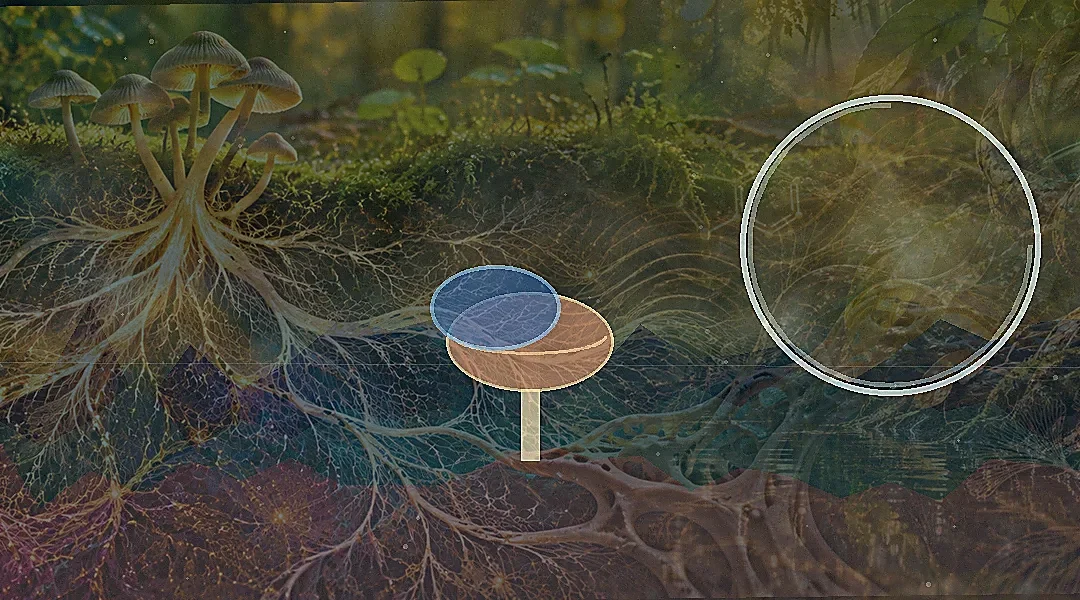
A pale mushroom is bruised, and blue spreads across the damaged flesh like ink through damp paper. It is an arresting little event. Generations of mycologists and psychonauts have wondered what that color signifies, sometimes treating it as a secret signature of the extraordinary chemistry inside certain fungi. The science has produced a wonderfully intricate answer.
In some psilocybin-producing mushrooms, injury triggers enzyme-driven reactions involving psilocin, ultimately forming blue-colored oxidation products. This is not simply a mushroom sweating blue psilocybin. Nor does blue bruising safely identify a species, prove edibility, or measure potency. The fascinating part is how a living organism can transform damage into a visible chemistry lesson.
When a mushroom is injured
A 2019 study of Psilocybe mushrooms identified two enzymes involved in the reaction. A phosphatase called PsiP removes a phosphate group from psilocybin, producing psilocin. A laccase called PsiL then oxidizes psilocin, initiating reactions that form blue chromophores—compounds whose electronic structures interact with light to generate visible color.
Subsequent structural and spectroscopic work further investigated these pigments, including products formed through oxidative coupling of psilocin molecules. The details are chemically complex, but the central idea is elegant: a physical injury changes which molecules can interact and how they are transformed. What appears to be a sudden splash of blue is a series of reactions unfolding within tissue.
This should not be confused with psilocin’s effects in the human nervous system. The fungal blueing reaction and the pharmacology of conscious experience are related through chemistry, but occur in entirely different biological settings.
An answer that opens another question
Why might a fungus possess an injury-responsive chemical system? Researchers have explored possible ecological roles, including defense. But demonstrating a reaction is not the same as proving the precise evolutionary reason it arose. Understanding what happens when a mushroom is cut does not, by itself, establish which predators or ecological pressures shaped the pathway.
It is tempting to turn every unusual feature into a grand ecological allegory. The better adventure is to observe how the organism actually lives. What might happen when insects or other animals damage fungal tissue? Do particular products influence interactions? Does the response vary across species? These are questions that can be investigated rather than answered by enthusiasm alone.
Does blue bruising prove that a mushroom is psychedelic?
No. Although this reaction is associated with some psilocybin-containing fungi, color alone cannot reliably identify an unknown mushroom. Other fungi can show blue or blue-green coloration through different pigments and pathways. Some psilocybin-containing mushrooms do not produce obvious bruising in every specimen or condition.
Mushroom identification involves a combination of features and, in difficult cases, microscopic, genetic and analytical evidence. A 2022 DNA-authentication and chemical-analysis study documented significant errors in the identification of Psilocybe material held in collections. If even curated research specimens can be misidentified, a blue mark in a phone photograph cannot be considered a safety certificate.
This matters because some poisonous fungi resemble psychoactive species. An unknown wild mushroom should never be consumed because it bruises blue, resembles an online image, or carries a familiar commercial nickname. When identification is uncertain, the consequences can be severe.
Is darker blue the same as greater potency?
Another enduring idea is that the strongest mushrooms must bruise the darkest blue. It sounds intuitively satisfying: a stronger visible signal should indicate more of the compound behind it. But bruise intensity depends on a complicated mix of tissue damage, available precursors, enzyme activity, timing and environmental conditions. It is not a standardized laboratory measurement.
Chemical potency is assessed through validated assays on accurately identified material. Even laboratory measurements need to account for sample handling, units, tissue type and variability. A color cannot tell you which concentration of psilocybin or psilocin is present, much less how an individual will experience it.
This is one reason our McKennaii mushroom article separates a commercial strain name, genetic identity, measured chemistry and personal reports. Each kind of information is interesting; none can be substituted for the others.
Color, perception and the beauty of a small reaction
Blueing offers a vivid example of why the relationship between chemistry and experience is so captivating. One set of molecules is rearranged in a fungus, and a conscious observer sees a color that may carry enormous symbolic significance. A chemist can investigate how the chromophore absorbs light. A painter can explore the emotional force of the blue. A psychonaut might find the whole scene a reminder of nature’s secret complexity.
Those interpretations need not compete. The chemical pathway does not make the visual experience less beautiful; the beauty does not require us to invent a supernatural function for the pigment. When we understand what the molecules are doing, the living process becomes more particular—and, to me, more extraordinary.
For the substance’s effects on the nervous system, see how psilocybin works. For the first-person transformation of sight itself, explore psilocybin and the five senses. A bruise on a mushroom and a transformed field of vision are very different phenomena, but each begins with matter participating in the strange work of consciousness.
The reaction has a molecular cast, not a single blue ingredient
When people describe a mushroom as “containing the blue stuff,” it creates the impression that a pigment has been sitting patiently inside the flesh, waiting to be exposed. The experiments tell a more dynamic story. In the injury-triggered pathway studied by Lenz and colleagues, the relevant compounds change as enzymes act on them. The color belongs to products of a reaction, not to a uniform reservoir of blue psilocybin.
The starting point is psilocybin, a phosphorylated tryptamine. A phosphatase, PsiP, can remove its phosphate group, yielding psilocin. A separate enzyme, PsiL, belongs to a family of multicopper oxidases known as laccases. It catalyzes oxidation reactions that help transform psilocin into reactive intermediates, which can couple with one another. Those products include larger structures with light-absorbing properties responsible for the familiar blue appearance. The 2020 paper established this cascade experimentally rather than simply inferring it from the color.
What makes this especially beautiful is the division of labor. One enzyme exposes a chemically reactive form; another drives oxidation; subsequent coupling produces a family of colored molecules. You can compare it loosely with a staged chemical performance: the effect emerges through a sequence, not because one actor was secretly painted blue from the start. The analogy is only an analogy, of course. A biochemical pathway has no intention to entertain.
For the actual experiments and their limitations, see Lenz and colleagues’ injury-triggered blueing study. The paper includes biochemical measurements, protein characterization, and identification of oxidation products. It is a better place to begin than a photographed mushroom surrounded by confident social-media commentary.
How the 2021 chemistry study made the picture sharper
Discovering the relevant enzymes is a major step. Yet knowing which enzymes act does not immediately tell us what every colored molecular species looks like. The oxidation products can be complex, variable and difficult to isolate. The result is not necessarily one tidy bottle of purified “magic mushroom blue.”
A 2021 structure-elucidation and spectroscopy study pushed further into the chemical identities of colored psilocin oxidation products. Researchers synthesized related compounds to make some structures more stable and easier to characterize. They used spectroscopic methods to investigate the electronic properties that allow these compounds to absorb visible light.
This matters because color is an interaction between molecules and light. The same broad family of starting molecules can lead to products with different optical characteristics. The blue of a damaged fungus is therefore evidence of biochemical transformation, not a label conveniently painted onto the psychoactive molecule itself.
There is a pleasing philosophical trap in the story. A human observer sees a blue bruise and recognizes a simple category. A spectroscopist sees a complicated set of reactions, interactions and measurements. Both observe something real. But they observe it at different levels of description. Mistaking the convenient visible category for the entire underlying mechanism is how a great deal of pseudoscientific mythology gets started.
Why injury and timing matter
An intact organism is not just a bag of ingredients. Cells organize reactions, control access to substrates and maintain environments that influence chemical processes. Damage disrupts that organization. A cut or bruise can bring molecules and catalytic pathways into conditions that make a visible reaction possible.
That is an important distinction from simply imagining that the mushroom has released a preexisting dye. Reaction rate depends on factors such as enzyme activity, substrate availability and exposure to oxygen. The precise behavior may vary with the specimen, tissue and conditions. A vivid blue mark appearing rapidly on one piece of tissue and a faint delayed change on another do not necessarily reveal a simple ranking of the mushrooms’ chemical composition.
Enzymatic oxidation also connects the blueing story to larger patterns in biology. Plants can brown when damaged; fruit can change color as compounds react; fungi can produce pigments through different pathways. These similarities are useful prompts for inquiry, but not evidence that the reactions are chemically identical. Nature often discovers several ways to turn injury into an observable transformation.
The temptation to treat every stain as a language of secret potency is understandable. We are visual animals. Our brains are quick to translate dramatic color into dramatic significance. Science is useful precisely because it asks whether that intuitive translation survives measurement.
The evolutionary story remains unfinished
If the blueing reaction is so striking, surely it must have evolved for a reason. That is a plausible question, not a result. Some researchers have discussed whether related compounds and rapid injury responses might influence interactions with predators or herbivores. Chemical defenses are common in nature. But identifying a molecular pathway does not demonstrate which ecological role, if any, explains its presence in a particular lineage.
To test a defensive function, investigators would need evidence about actual ecological interactions: whether potential consumers avoid or are affected by damaged tissue, what concentrations occur under natural conditions, how traits vary across populations, and whether the proposed benefits plausibly outweigh costs. Laboratory production of a pigment is not the same thing as ecological selection.
One hypothesis concerns how oxidative products might affect other organisms, potentially through chemical reactivity. That is worth studying. It should not be promoted to the status of a discovered universal purpose for psilocybin-producing mushrooms. The history of biology contains more than enough examples of adaptive stories that were elegant, popular and eventually found wanting.
It is possible to admire the system without inventing its intentions. That restraint is not the enemy of wonder. If anything, the presence of an unresolved evolutionary question gives researchers something better than a tidy moral: an actual hypothesis.
Blue is not a species name, and a species name is not a chemical test
There is a taxonomy lesson hiding under the bruise. A scientific species is a hypothesis about biological identity and relationships, typically informed by multiple lines of evidence. A commercial “strain” name may be a trade label or informal lineage description. An observed blue reaction is a chemical or physical trait. A measured concentration of psilocybin is an analytical result. These are different categories, even when a conversation treats them as interchangeable.
A 2022 study combining DNA authentication and chemical analysis of Psilocybe specimens documented substantial misidentification and variability. The point is not that every historical record becomes useless. It is that scientific conclusions grow less reliable when the organisms being measured are mislabeled or poorly documented.
The lesson applies well beyond psychedelics. If a study says a species contains a certain chemical, we should ask how the species was identified, whether voucher material exists, whether the sample was fresh or stored, and which analytical methods were used. If a person says a particular commercial line “always” produces a distinct kind of trip, the same demand for controls applies even more strongly. Anecdote can suggest a question; it cannot supply a validated chemical fingerprint or a guaranteed experience.
Browse our discussion of McKennaii’s commercial naming and evidence for a related case. The odd thing about magic-mushroom mythology is how often the visible bruise gets treated as more objective than the hidden variables that actually matter.
The difference between looking and identifying
A photograph is excellent for appreciating the extraordinary appearance of damaged fungal tissue. It is a very poor substitute for reliable identification when the consequences of a mistake could be serious. Lighting, camera processing, surface moisture and the age of the specimen can all change how color appears. Even in person, a single visible characteristic is rarely enough to resolve a difficult identification.
Mycology relies on combinations of macroscopic features, microscopic structures, ecology, collection history and increasingly DNA-based tools. Some questions require chemical analysis as well. None of this means every mushroom needs a genome to be named, but it does mean that a blue stain should never function as permission to ingest an unknown specimen.
Poisonous mushrooms are not obligated to look threatening. Nor are psychoactive mushrooms obligated to advertise their chemistry in a way that a phone camera can decode. In the presence of serious uncertainty, the appropriate response is not another confident online guess. It is to avoid consumption and consult qualified local expertise for identification. A fascinating chemistry lesson must not become an accidental foraging guide.
What the blueing reaction can teach us about seeing
There is something wonderfully self-referential about the problem. A mushroom associated with alterations in human perception presents a highly visible chemical reaction, and observers build stories around the color. The fungus makes molecules; the visual system makes an experience of blueness; a culture makes a mythology. Each step adds another layer, but none erases the others.
Donald Hoffman’s questions about perception as an interface can serve as a speculative lens here, not as an explanation of a specific enzyme pathway. We never perceive an isolated molecule directly. We perceive the world through biological and cognitive systems that organize information into forms we can use. A bruise becomes a blue patch, then a meaningful sign, then perhaps a story about the nature of reality. The science of oxidation does not settle the philosophy of consciousness, and the philosophy does not rewrite the chemistry.
A better inquiry asks how the layers connect. What is measured? What is inferred? Which relationships are causal, and which are parallels that merely suggest another question? For the nervous-system side of the topic, see how psilocybin works and psilocybin and the senses. The connections are intriguing precisely because they are not all the same phenomenon.
The blue mystery that chemistry made richer
For years the blue stain invited speculation. Careful experiments have now revealed much of the chemical machinery that produces it, while leaving further biological and ecological questions alive. This is how good science often proceeds: not by scraping away every trace of wonder, but by replacing a vague mystery with several precise and even more interesting ones.
The next time you see a blueing fungus in a photograph, it is worth remembering how many different questions the image contains. What species is it? Which compounds and enzymes are involved? What does the reaction do in nature? And why does this small transformation seem so beautiful to the human eye? We have begun to answer some of them. The others are good reasons to keep looking.
Sources
Injury-Triggered Blueing Reactions of Psilocybe Mushrooms (2019/2020); Structure Elucidation of Oxidative Psilocin Chromophores (2021); DNA Authentication and Chemical Analysis of Psilocybe Mushrooms (2022); Chemical Composition and Biological Activities of Psilocybe Mushrooms (2025). None permits identification of an unknown specimen on color alone.
Key concepts
Brief definitions for terms used in this article.
psilocybin
A naturally occurring compound that the body converts to psilocin; its effects and risks depend on many factors.
More reading tools
Your Reading Shelf
Saved only in this browser.