


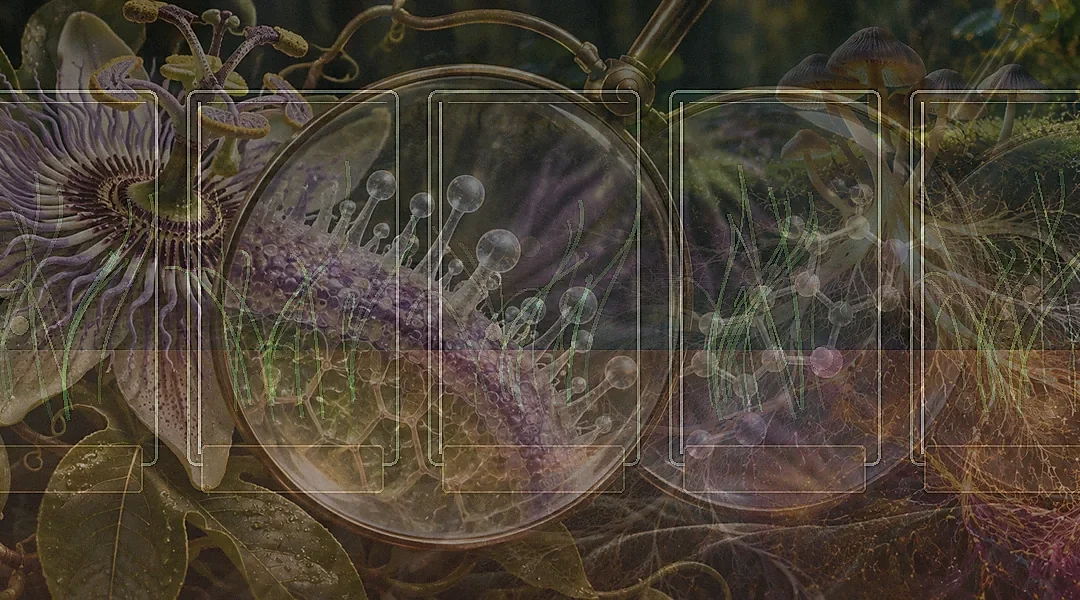
The idea has a certain mycological elegance: if one mushroom can open unusual doors in perception and another has been investigated for its effects on nerve growth and cognition, perhaps combining them might do something extraordinary. Add an ordinary vitamin, give the combination a memorable name, and a small contemporary ritual takes shape. It is exactly the kind of pattern a curious psychonaut would want to explore.
That curiosity has a well-known expression in the Stamets stack, a proposed combination usually discussed in relation to psilocybin, lion’s mane mushroom and niacin. The idea circulates widely in microdosing communities. Its appeal is understandable, particularly given Paul Stamets’s long-standing public enthusiasm for fungi and their biochemical possibilities.
But an interesting hypothesis and an established clinical intervention are different things. There is not yet strong randomized clinical evidence that combining psilocybin, lion’s mane and niacin produces a unique, reliable mental-health or cognitive benefit. The research is growing, and there are meaningful details to examine. The most rewarding approach is to follow them carefully rather than dismissing the idea or declaring it proven.
What does “stacking” mean in this context?
In microdosing culture, a stack is a combination of substances or supplements chosen in the hope that their effects will complement one another. The word is borrowed from nootropics and supplement communities, where combining ingredients is common even when rigorous interaction studies are scarce. An appealing rationale can make the individual parts seem more established than they are.
The best-known psilocybin stack pairs a psychedelic substance with Hericium erinaceus, the culinary and medicinal fungus commonly called lion’s mane, and niacin, a form of vitamin B3. Different communities use the name in somewhat different ways, so a scientific article should describe its components rather than assume every person follows one identical practice.
Stacking is not a single pharmacological category. It is a cultural practice involving multiple molecules, often with varying formulation and source quality. Even an individual ingredient with known biological activity does not guarantee that a mixture will have additive, synergistic or beneficial effects in humans.
Why lion’s mane captured the imagination
Lion’s mane has become a particularly intriguing fungus because laboratory and animal studies have examined compounds such as hericenones and erinacines in relation to nerve growth factor signaling and other neurobiological processes. There is also a smaller human research literature on cognition and mood. The subject is not mere fantasy; it contains legitimate biochemical questions.
What it does not contain is a clinical demonstration that all commercial lion’s mane products have the same composition, that laboratory findings predict a particular human outcome, or that combining the fungus with psilocybin will reproduce a molecular effect suggested by preclinical models. Extracts, fruiting bodies, mycelial preparations and manufacturing methods can differ. A product name is not a chemical assay.
There is an almost irresistible symbolic relationship here: fungi, neural branching and the human imagination each seem to offer their own kind of network. The visual parallel can inspire art or a research question. It is not itself proof that a particular combination grows new brain connections in people.
The niacin hypothesis
Niacin has established roles in human metabolism as vitamin B3. Certain forms and amounts can cause flushing, a sensation of warmth and redness produced by changes in blood vessels. In discussions of the stack, this visible physiological effect has sometimes been recruited into a larger theory about distributing or enhancing other ingredients.
A flush is evidence that niacin has produced a physiological effect, not evidence that a psychedelic combination has successfully reached a particular brain region or enhanced neuroplasticity. The proposed mechanism needs direct experimental testing. The fact that one component generates an unmistakable bodily sensation can easily be mistaken for confirmation of the whole theory.
Niacin can also cause adverse effects, especially with higher exposures, and may be unsuitable for people with particular health conditions or medications. A nutritionally familiar vitamin does not become risk-free when used outside its ordinary dietary context. There is no sensible reason for an article to convert the hypothesis into a self-experimentation protocol.
What observational research actually observed
In 2022, researchers published a large prospective observational study of people who reported microdosing psilocybin. They examined changes in mood and mental-health measures over about a month, comparing microdosers with non-microdosing controls and considering whether some people reported combining psilocybin with lion’s mane or niacin.
Microdosers reported greater improvements on some measures than non-microdosing controls. That result attracted attention for understandable reasons. But the participants were not randomly assigned to well-characterized products under double-blind conditions. Expectations, selection effects, individual circumstances and concurrent practices could all have contributed.
Crucially, the study’s analysis did not establish a general additional mood or mental-health benefit from adding lion’s mane and niacin to psilocybin. Some exploratory findings varied by age or particular measures. Such subgroup signals are hypothesis-generating; they aren’t a clinical demonstration that a stack reliably outperforms psilocybin alone.
The 2022 prospective study is worth reading for its actual methods and limits. It shows that people are making these combinations and that their experiences can be studied. It does not transform a popular practice into a validated treatment.
The broader microdosing evidence is more uncertain than the stories
Microdosing research faces a difficult problem. Many people who choose the practice bring strong expectations about creativity, mood, attention or psychological flexibility. Those experiences deserve documentation, but expectancy can influence self-reported outcomes. When randomized, blinded comparisons are introduced, effects often appear more modest or inconsistent than naturalistic testimonials suggest.
A 2026 umbrella review of classical psychedelic microdosing, mood and cognition found that self-reported mood benefits were substantially attenuated under placebo-controlled conditions, and emphasized the need for stronger, preregistered trials. A separate 2026 systematic review and meta-analysis of studies in healthy adults found little consistent evidence for sustained improvements in mood or cognition.
Neither conclusion means that everybody reporting a meaningful personal experience is wrong. It means the existing group-level evidence cannot guarantee an effect for the next person. Nor can results from microdosing be borrowed from full-dose psilocybin psychotherapy trials: the exposures, settings and clinical questions are different.
The 2026 umbrella review and 2026 systematic review provide a better starting point than a viral graphic assigning certainty to each ingredient.
What the 2022 observational result can and cannot isolate
The much-discussed 2022 Scientific Reports study followed 953 people who reported psilocybin microdosing and 180 non-microdosing comparators for roughly one month. It reported modest improvements in several mood and mental-health measures in the microdosing group. That is interesting data about self-selected people in real life, not an experiment in which scientists assigned the participants to a defined stack or a placebo.
The investigators also examined variations in people’s combinations. In particular, the addition of lion’s mane and niacin did not establish a general extra benefit for mood or mental health. An exploratory psychomotor signal among older adults was intriguing but limited: it was not a demonstration that combining the ingredients produces a reliable clinical cognitive effect across ages.
That distinction matters because a study that includes people who happen to use a stack is easily presented as a study that tests the stack. It is not. Ingredients, expectations and other habits can differ between groups. The people choosing supplements may also differ in the very outcomes researchers want to measure.
There is a further conflict-of-interest question worth asking. Paul Stamets was a study co-author and has commercial and intellectual-property interests related to fungal products. Disclosed interests do not negate the data, but they make transparent methodology and independent replication especially important. The appropriate response is to read the paper and its disclosures, not to treat either admiration or suspicion as a substitute for analysis.
What the 2026 reviews add to the argument
The research landscape is now broader than the 2022 naturalistic study. A 2026 systematic review and meta-analysis of microdosing in healthy adults examined 24 studies, including randomized trials, and found little consistent evidence for sustained cognitive or mood improvement under controlled conditions. Another 2026 umbrella review found that self-reported mood benefits tended to diminish with placebo controls.
These results do not directly test every possible combination involving lion’s mane and niacin. They do establish why the most optimistic stack narratives need careful interpretation: if evidence for the underlying microdosing component is itself mixed, claims that adding two more ingredients produces a reliable enhancement require evidence designed specifically for the combination.
The 2026 psilocybin-microdosing systematic review also notes how heterogeneous the field is. Studies use different preparations, measures and participant populations. An observed change in a self-reported mood scale cannot be transferred automatically to a claim about nerve regeneration, creativity or an enduring clinical treatment response.
Why composition and consent matter more than a clever formula
Even if a combination sounds biologically elegant, its actual ingredients may be inconsistent. Lion’s mane is a real fungal species, Hericium erinaceus, but extracts and supplements can differ in the part of the fungus used, the extraction process and the substances quantified. Niacin is a vitamin with its own physiological effects; “natural” does not mean that unlimited amounts are safe.
Psilocybin-containing mushroom preparations also vary. Commercial strain names and informal potency claims are not replacements for chemical measurement. Without defined preparations, it is hard to know whether two people describing the same “stack” are studying or consuming anything equivalent.
A responsible trial would need carefully characterized material, informed consent, independent outcome measures, clear reporting of adverse reactions and groups capable of distinguishing the individual components from any interaction. The goal would be to answer a scientific question, not to reverse-engineer a justification for an appealing recipe.
This is why the most honest conclusion can be more intellectually interesting than the marketing: the relationship between fungal chemistry and human cognition is real and worth investigating, but the popular stack remains a hypothesis rather than an established therapy.
Synergy is a scientific claim, not a poetic one
“Synergy” has a specific implication: the combination produces an effect different from or greater than what would be expected from its components under an appropriate comparison. To demonstrate that, investigators would need carefully characterized ingredients, comparison groups that can isolate each component and the combination, meaningful outcome measures, safety monitoring and adequate follow-up.
That experiment is more complex than collecting a series of enthusiastic testimonials. It also needs to ask whether any perceived benefit is worth the added burden or risk of combining ingredients. A mixture that feels more elaborate is not necessarily more useful.
There is a philosophical charm in seeing meaningful relationships among fungi, human cognition and artistic pattern. McKenna and Stamets have both helped make the fungal world seem less ordinary to many psychonauts. Their curiosity should inspire better questions, not exempt their ideas from testing. If a genuine synergy exists, disciplined research is how we might someday discover what it is.
Interactions and uncertainties deserve real attention
Combining multiple substances complicates the interpretation of both desired and unwanted effects. The composition of unregulated products can be uncertain; individual medical conditions and prescribed medications may change the risks. Different supplements have their own adverse-event profiles and potential interactions. A person considering any psychoactive or supplemental regimen should discuss relevant medical concerns with a qualified clinician.
There are also long-term questions. Reviews in 2026 have noted that safety and consequences of repeated, low-level serotonergic exposure are insufficiently characterized, including theoretical cardiovascular concerns that require further study. A lack of obvious immediate discomfort is not equivalent to established long-term safety.
Our overview of microdosing research considers these broader questions, while microdosing versus macrodosing explains why different forms of psychedelic exposure shouldn’t be treated as interchangeable clinical claims.
The useful mystery at the center of the stack
A popular stack expresses a real human intuition: perhaps combining the right biological influences could change how we think, feel or learn. There are intriguing reasons to study fungi, molecules and plasticity. But the elegance of a concept can outrun the strength of its data, particularly when stories travel faster than controlled comparisons.
There is no need to choose between celebration and contempt. Let the curiosity remain alive. Take each ingredient seriously as chemistry rather than as a symbol, compare outcomes honestly, and remember that what is appealing in a theory has not yet been demonstrated in a patient. The fungal world is strange and rich enough to reward a lifetime of investigation without requiring premature certainty.
Sources and further reading
Polito/Rootman et al. (2022), prospective psilocybin microdosing study and stacks; Classical Psychedelic Microdosing, Mood and Cognitive Function (2026 umbrella review); Efficacy and Safety of Psychedelic Microdosing (2026 review and meta-analysis); The Subtle Science: A 2026 Review of Psilocybin Microdosing; NIH NCCIH: Psilocybin for Mental Health and Addiction. Observational reports can generate hypotheses, but they do not prove a combination’s clinical efficacy or safety.
Key concepts
Brief definitions for terms used in this article.
neuroplasticity
The capacity of neural systems to change over time through experience, learning or other influences.
psilocybin
A naturally occurring compound that the body converts to psilocin; its effects and risks depend on many factors.
More reading tools
Also connected to this article
These published essays link here through Atlas-curated or editor-selected connections.
Your Reading Shelf
Saved only in this browser.