
Psychedelic art uses color, pattern, distorted perspective and unexpected imagery to make the familiar feel strange. A face becomes a landscape. Lettering bends into a living shape. Mushrooms grow into miniature worlds, and an ordinary eye starts looking suspiciously like a window into the universe.
But there is more to the style than turning up the saturation. Its most interesting work changes how you look: drawing you into repeating forms, hiding one image inside another, or making a flat surface feel unusually deep. This guide explores that visual language, its roots in poster design, and how it works across prints, clothing and digital imagery.
What makes art psychedelic?
Psychedelic art is a broad description rather than a single technique. It can refer to work inspired by altered states, the graphic culture associated with psychedelia, or imagery that plays with perception. An artwork does not need a drug reference to fit the description, and a mushroom illustration is not automatically psychedelic.
Look at what the image does, as well as what it depicts:
- Color relationships: sharply contrasting colors can make edges seem restless, while gradual shifts can suggest depth or atmosphere.
- Repetition: nested shapes, radiating lines and recurring details encourage the eye to keep moving.
- Transformation: bodies, plants, animals and landscapes merge or change scale in ways that interrupt everyday logic.
- Figure and background: the space around a subject may become another subject, making the composition readable in more than one way.
- Expressive lettering: words can function as shapes, with their rhythm and placement becoming part of the picture.
No piece needs all five. A restrained black-and-white drawing can be more disorienting than a rainbow with an eyeball pasted on it. Color helps; composition does the work.
From Art Nouveau to psychedelic concert posters
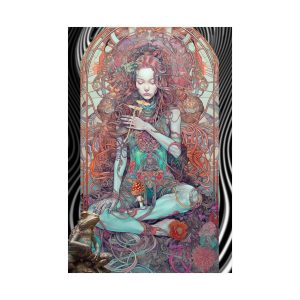
The San Francisco concert-poster scene of the 1960s helped establish a recognizable psychedelic graphic style. Wes Wilson, Stanley Mouse and Alton Kelley were among the designers who adapted older visual influences for a new musical and cultural setting.
Those influences matter. Flowing outlines, elaborate borders and lettering shaped around a composition had precedents in Art Nouveau and related design movements. Psychedelic poster artists transformed that vocabulary through new color combinations, distorted typography and unexpected imagery.
Poster House’s illustrated account of Wes Wilson’s influences compares his work with designs by Alfred Roller, Alphonse Mucha and others. Seeing the examples side by side makes the connection more useful than simply calling every swirling poster “trippy.”
A concert poster also had a practical job: announce a performance and make people notice it. That tension between information and visual experimentation is part of its appeal. You can recognize a powerful composition before you have untangled every word.
Psychedelic, visionary and surreal art: where they overlap
These labels are useful, but their boundaries are porous. As a way of looking at an image, “psychedelic” draws attention to altered perception and visual intensity. “Visionary” often emphasizes an imagined inner world or spiritual symbolism. “Surreal” points toward dream logic, impossible combinations and disruptions of ordinary reality.
One artwork can invite all three readings. A figure dissolving into a geometric landscape may suggest a dream, a spiritual experience or a playful experiment with shape. None of those interpretations requires treating the image as a literal record of another realm.
For examples within our collections, explore Visionary Dreamscapes, which brings together surreal psychedelic imagery across different product formats.
Reading the symbols without flattening their meaning
Eyes, mushrooms, cosmic travelers and repeating geometry give artists a vocabulary for curiosity, uncertainty and transformation. Their meanings depend on the individual work. An eye might suggest attention, surveillance, self-awareness or simply a strong visual focal point.
Spiritual imagery deserves more specificity. A depiction of Ganesha carries religious and cultural associations beyond its use in a psychedelic composition. Geometric patterns also come from many different traditions; they are not all interchangeable evidence of one universal message.
A useful question is: what does the symbol contribute here? Does it organize the picture, tell a story, create a joke or introduce a tension? That question leaves more room for the artist—and the viewer—than assigning every mushroom, deity and spiral the same meaning.

How psychedelic imagery changes across media
Posters and wall art: room for discovery
A print gives intricate imagery a fixed space. From across the room, the silhouette and color balance matter most. Up close, smaller figures, repeated motifs and hidden details can reward a second look. When choosing a design, consider both distances rather than judging only a thumbnail.
Our psychedelic art posters and visionary prints bring mushroom worlds, cosmic characters and surreal scenes into that wall-art format. Check the individual listing for available dimensions and material details before choosing a print.
Clothing: composition on a moving surface
A shirt changes the viewing conditions. Fabric folds, the wearer moves, and the image is often seen briefly. A strong central shape or readable phrase can carry the idea even when the smallest details disappear. Dense artwork can still work, but placement and scale become especially important.

Explore our psychedelic T-shirts for examples of imagery adapted to clothing. Compare the design placement as well as the artwork, and use the product’s size chart rather than assuming every shirt fits alike.
Digital imagery: change becomes part of the artwork
Digital tools allow artists to build repeating forms, layered environments and sequences that would be difficult to reproduce by hand. In animation, a transformation can unfold over time instead of being implied in one frame. A static print of that work has a different challenge: choosing the moment that stands on its own.
Art can invite reflection without promising revelation
Psychedelic imagery can feel funny, unsettling, beautiful or personally meaningful. A viewer may connect it with a dream, a memory or an experience that is difficult to describe. Another person may simply like the colors. Both responses are legitimate.
An image does not establish a scientific claim about consciousness or guarantee healing. Its value can be more direct: it holds your attention, gives an experience a visual form, or makes you notice something you would otherwise overlook. You do not need to have taken psychedelics to appreciate it.
Psychedelic art at PsychonautDream
PsychonautDream brings psychedelic culture into prints, clothing and everyday objects. The imagery ranges from contemplative scenes to cosmic absurdity: mushrooms, strange travelers, impossible landscapes and characters who appear to have misplaced the instruction manual for reality.
Read about PsychonautDream and its art for more background. When choosing a piece, start with the image you want to keep looking at, then choose the format that suits it. The wall and the wardrobe are different canvases; neither needs to be boring.